The Dangote Petroleum Refinery IPO has officially opened, giving Nigerian investors a chance to own a stake in one of Africa’s biggest industrial projects. Shares are being offered at ₦525 each, with the offer set to run from September 14 to October 13, 2026. The refinery is currently valued at about $47.6 billion, making this one of the biggest investment opportunities ever offered to the Nigerian public.
But here is the question investors should be asking before they rush to buy: Is Dangote Refinery actually worth ₦525 per share? The refinery is impressive, but a great business is not automatically a great investment at any price.
In this analysis, we will compare Dangote Refinery with major global refineries, examine its valuation, profits, growth plans and risks, and determine whether the Dangote Refinery IPO is fairly priced, overhyped, or potentially undervalued.
What Investors Are Actually Buying
The Dangote Refinery IPO is offering shares at ₦525 each, with investors able to buy a minimum of 10 shares (₦5,025). The offer includes 4.1 billion shares and could raise about ₦2.15 trillion if fully subscribed.
How Much Is Dangote Refinery Worth?
At ₦525 per share, the refinery is being valued at about ₦63 trillion, or $47.6 billion. This is the figure you should compare with other global refiners, not simply the price of one share.
What the IPO Proceeds Will Be Used For
The money raised will mainly support the planned expansion of the refinery from 700,000 to 1.4 million barrels per day by 2029. The wider expansion is expected to cost about $14.3 billion, with the IPO providing only part of the funding.
How Big Is Dangote Refinery Compared With Global Refineries?
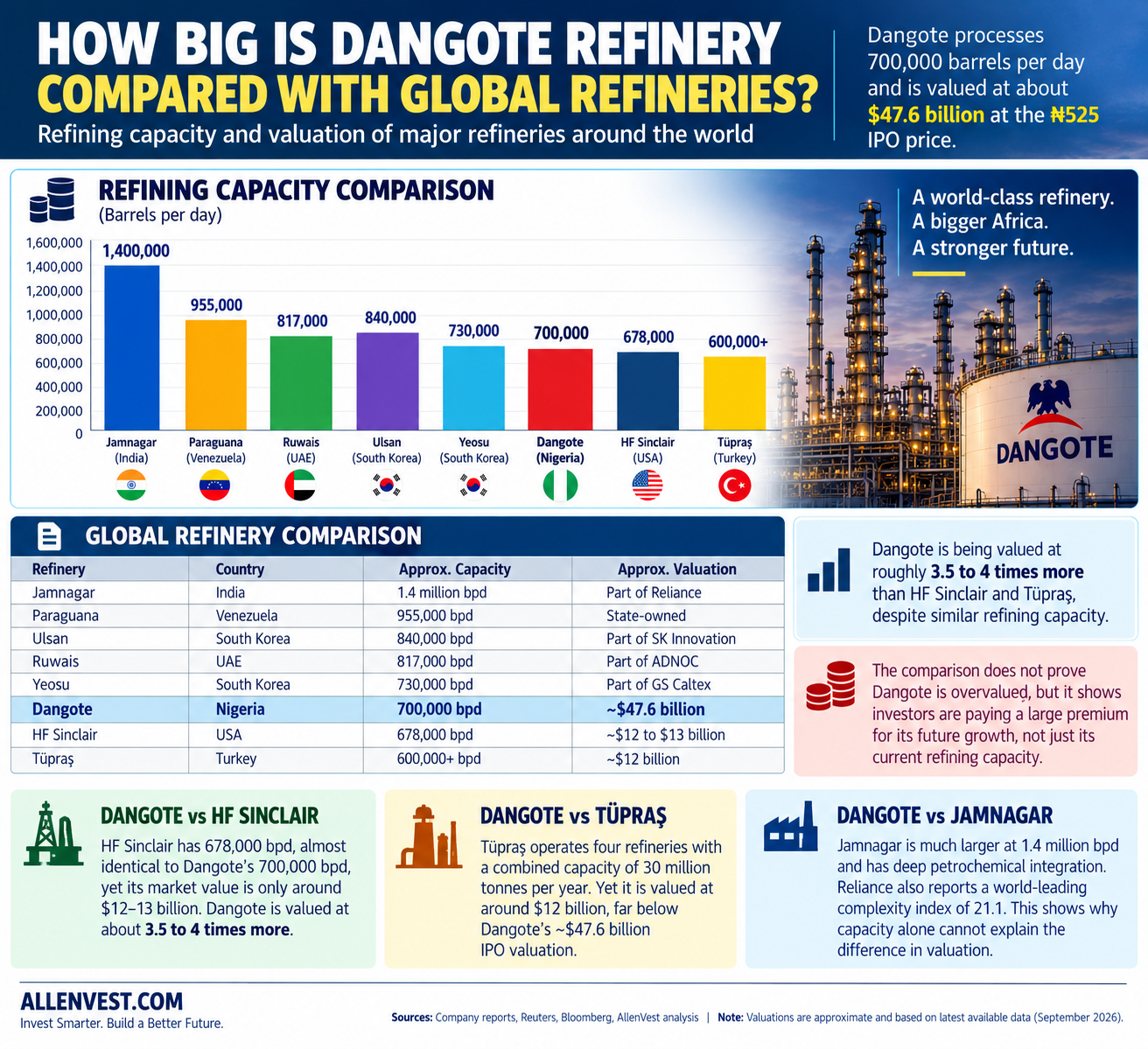
Dangote Refinery currently processes about 700,000 barrels of crude per day and is valued at roughly $47.6 billion at the ₦525 IPO price. That valuation becomes more interesting when compared with companies operating refineries of similar size, because Dangote is being priced at a much higher level than some established global peers.
| Refinery | Country | Approx. Capacity | Approx. Valuation |
| Jamnagar | India | 1.4 million bpd | Part of Reliance |
| Paraguana | Venezuela | 955,000 bpd | State-owned |
| Ulsan | South Korea | 840,000 bpd | Part of SK Innovation |
| Ruwais | UAE | 817,000 bpd | Part of ADNOC |
| Yeosu | South Korea | 730,000 bpd | Part of GS Caltex |
| Dangote | Nigeria | 700,000 bpd | ~$47.6 billion |
| HF Sinclair | USA | 678,000 bpd | ~$12 to $13 billion |
| Tüpraş | Turkey | 600,000+ bpd | ~$12 billion |
Dangote vs HF Sinclair
The comparison with HF Sinclair is particularly revealing. HF Sinclair has 678,000 barrels per day of refining capacity, almost identical to Dangote’s current 700,000 bpd, yet its market value is only around $12–13 billion. Dangote is therefore being valued at roughly 3.5 to 4 times more, despite having similar current refining capacity.
Dangote vs Tüpraş
Tüpraş operates four refineries with a combined capacity of 30 million tonnes per year, making its refining scale broadly comparable with Dangote’s. Yet Tüpraş has been valued at around $12 billion, far below Dangote’s approximately $47.6 billion IPO valuation.
Dangote vs Jamnagar
Jamnagar is a different comparison because it is significantly larger at about 1.4 million barrels per day and has a much deeper petrochemical integration. Reliance also reports a world-leading complexity index of 21.1 for the complex. Yet analysts have argued that Dangote’s IPO valuation creates an interesting valuation gap with Reliance’s oil-to-chemicals business, showing why capacity alone cannot explain the difference in value.
The comparison does not prove that Dangote is overvalued. Dangote is a newer refinery with a major African market opportunity and plans to double capacity to 1.4 million bpd, but the numbers show exactly why the IPO deserves serious scrutiny: investors are paying a very large premium for Dangote’s future growth, not just its current refining capacity.
Why Dangote Refinery Deserves a Premium
1. Its Massive Refining Capacity
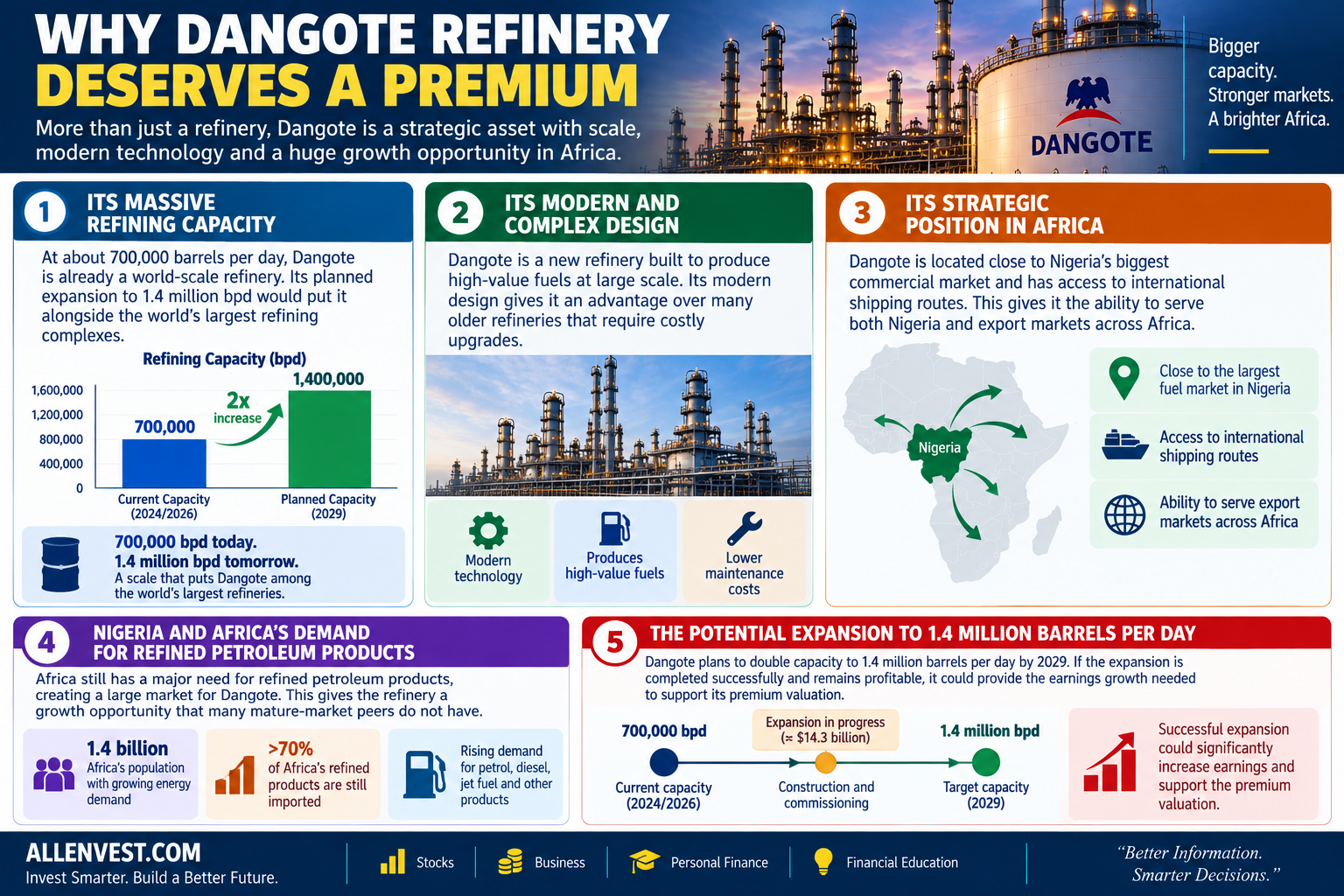
At about 700,000 barrels per day, Dangote is already a world-scale refinery. Its planned expansion to 1.4 million bpd would put it alongside the world’s largest refining complexes.
2. Its Modern and Complex Design
Dangote is a new refinery built to produce high-value fuels at large scale. Its modern design gives it an advantage over many older refineries that require costly upgrades.
3. Its Strategic Position in Africa
Dangote is located close to Nigeria’s biggest commercial market and has access to international shipping routes. This gives it the ability to serve both Nigeria and export markets across Africa.
4. Nigeria and Africa’s Demand for Refined Petroleum Products
Africa still has a major need for refined petroleum products, creating a large market for Dangote. This gives the refinery a growth opportunity that many mature-market peers do not have.
5. The Potential Expansion to 1.4 Million Barrels Per Day
Dangote plans to double capacity to 1.4 million barrels per day by 2029. If the expansion is completed successfully and remains profitable, it could provide the earnings growth needed to support its premium valuation.
Why the ₦525 IPO Price Raises Questions
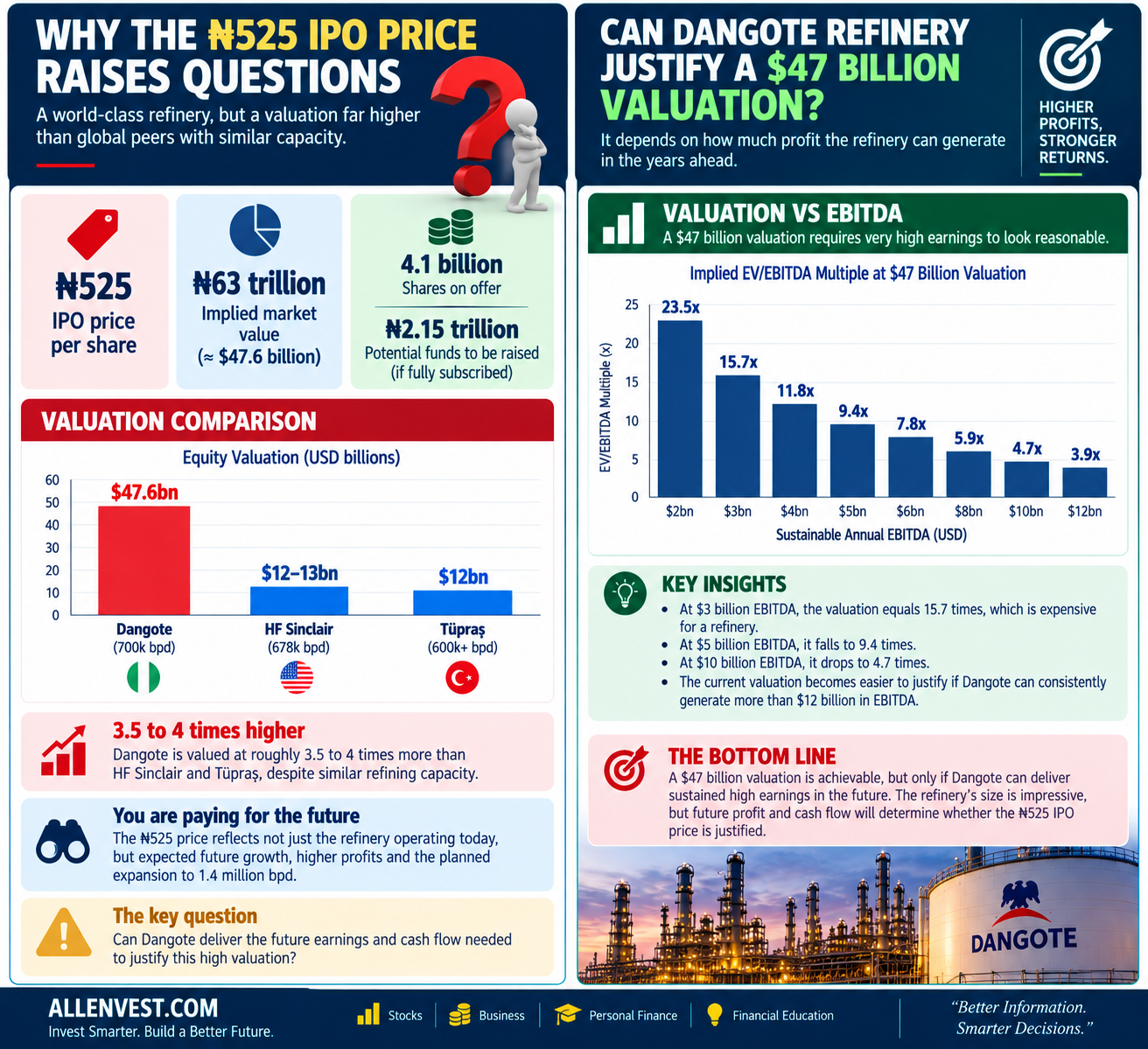
At ₦525 per share, Dangote Refinery is being valued at about $47.6 billion. That is a very high valuation compared with HF Sinclair and Tüpraş, which have similar refining capacity but much lower market values.
The key issue is that you are not paying only for the refinery operating today. You are also paying for expected future growth, higher profits and the planned expansion to 1.4 million barrels per day. The refinery’s size is impressive, but future profit and cash flow are hat will determine whether the IPO price is justified.
Can Dangote Refinery Justify a $47 Billion Valuation?
At a valuation of about $47 billion, Dangote Refinery is being priced on the belief that its profits will become much larger in the years ahead. The refinery has already shown that it can generate significant earnings, but investors should ask whether those earnings can remain strong enough to support such a large valuation.
One simple way to test this is to compare the valuation with the company’s EBITDA. At $3 billion in sustainable annual EBITDA, a $47 billion valuation would equal about 15.7 times EBITDA, which is expensive for a refinery. At $5 billion, it falls to 9.4 times, while $10 billion would bring it down to 4.7 times.
This is why Dangote’s long-term target of more than $12 billion in EBITDA is so important. If the company eventually reaches that level consistently, the current valuation becomes much easier to defend. The problem is that $12 billion is a future target, not a level of profit Dangote Refinery has already demonstrated.
The Risks Investors Should Not Ignore
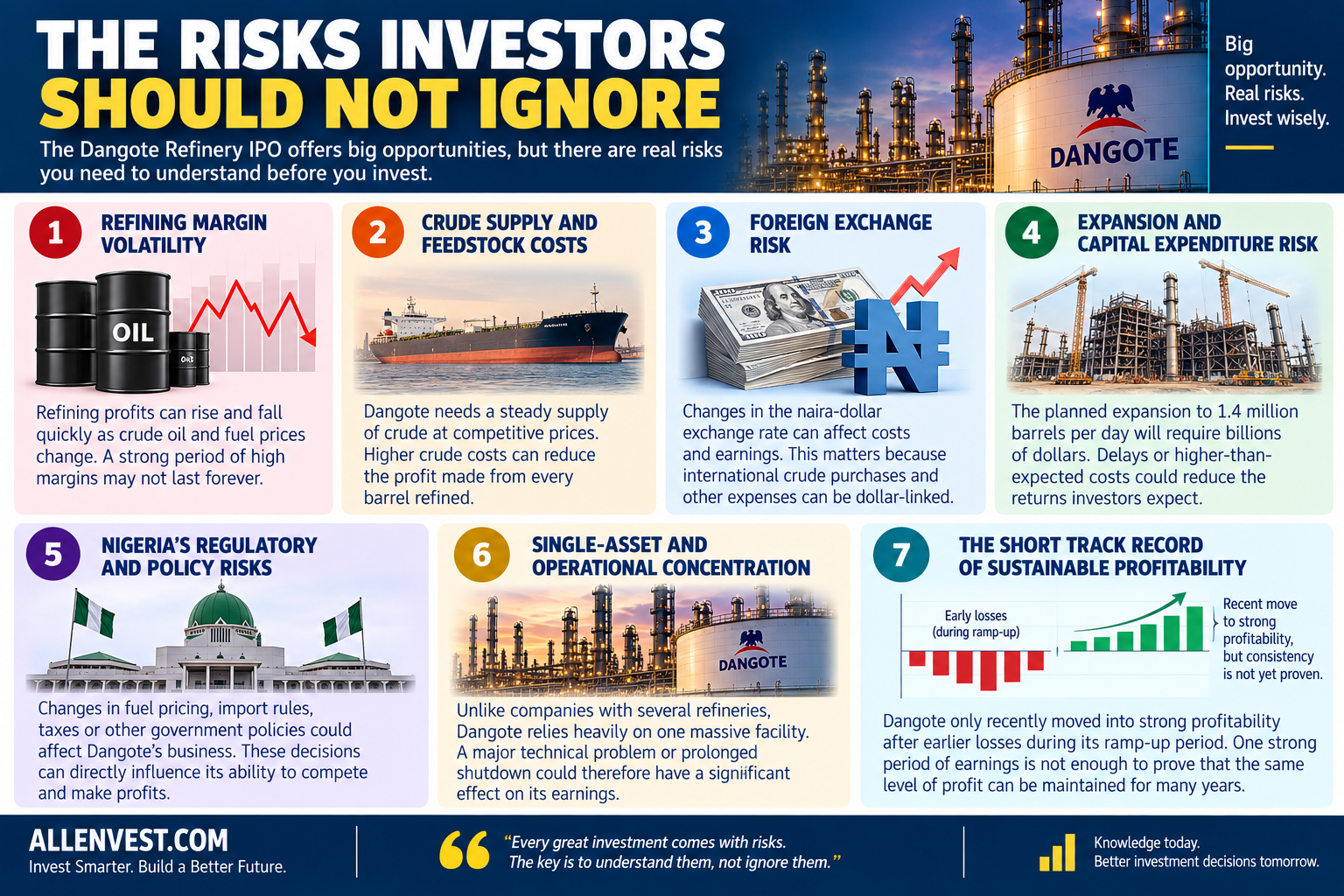
1. Refining Margin Volatility
Refining profits can rise and fall quickly as crude oil and fuel prices change. A strong period of high margins may not last forever.
2. Crude Supply and Feedstock Costs
Dangote needs a steady supply of crude at competitive prices. Higher crude costs can reduce the profit made from every barrel refined.
3. Foreign Exchange Risk
Changes in the naira-dollar exchange rate can affect costs and earnings. This matters because international crude purchases and other expenses can be dollar-linked.
4. Expansion and Capital Expenditure Risk
The planned expansion to 1.4 million barrels per day will require billions of dollars. Delays or higher-than-expected costs could reduce the returns investors expect.
5. Nigeria’s Regulatory and Policy Risks
Changes in fuel pricing, import rules, taxes or other government policies could affect Dangote’s business. These decisions can directly influence its ability to compete and make profits.
6. Single-Asset and Operational Concentration
Unlike companies with several refineries, Dangote relies heavily on one massive facility. A major technical problem or prolonged shutdown could therefore have a significant effect on its earnings.
7. The Short Track Record of Sustainable Profitability
Dangote only recently moved into strong profitability after earlier losses during its ramp-up period. One strong period of earnings is not enough to prove that the same level of profit can be maintained for many years.
Great Refinery, But Is It a Great Investment at ₦525?
The Dangote Refinery IPO introduces an indicative market valuation of ₦65.22 trillion (approximately $47 billion to $49 billion).
- Share Price: ₦525 per share.
- Minimum Purchase: 10 shares, costing a total of ₦5,250.
- Offer Period: Opens September 14, 2026, and closes October 13, 2026.
- Total Shares Offered: 4.1 billion ordinary shares.
- Target Raise: Approximately ₦2.15 trillion ($1.6 billion).
At about $47 billion, the IPO price suggests that investors are already paying for a large part of the company’s future growth. For ₦525 to make sense, several things must go right. Dangote Refinery needs strong refining margins, high capacity utilisation, reliable crude supply, growing profits, healthy cash flow and disciplined spending on its expansion. Investors should also watch debt, free cash flow and return on invested capital rather than being impressed by the refinery’s size alone.
My view is simple: Dangote Refinery is an exceptional asset, but ₦525 demands exceptional financial performance. At this price, you are buying not only what Dangote Refinery is today, but also what management expects it to become tomorrow.
That is why I would not judge the Dangote Refinery IPO by headlines, patriotism or the size of the project. Judge it by earnings, cash flow, margins, debt, utilisation and return on invested capital. If those numbers continue to improve strongly, ₦525 could eventually look reasonable. If profits weaken or the expected growth fails to materialise, the same ₦525 could prove very expensive.
Omoare Allen Investment Strategy for Dangote Refinery Shares
I am approaching the Dangote Refinery IPO with a dollar-cost averaging strategy. I will divide my planned investment into four equal parts, putting the first 25% into the IPO and keeping the remaining 75% available for future opportunities.
After my first entry, I will closely study how the market responds to the stock. I will look at fundamentals, market sentiment and technical price action, while also watching the refinery’s earnings, margins, capacity utilisation, cash flow, crude supply and progress toward full operations. If the business and market conditions improve, I will deploy another portion of my capital at a better risk-reward point.
I will also pay close attention to Nigerian politics and government policy, especially as elections are months away. Dangote Refinery operates in an industry where fuel pricing, crude supply, import policies, taxation and other government decisions can have a major effect on the business.
The remaining 75% is not money I must invest. If the fundamentals deteriorate, the valuation becomes even less attractive, or the political and operational risks increase, I am prepared to keep the capital on the sidelines. The goal is not to buy all the shares I can today. The goal is to build my position only when the numbers and market conditions give me enough reason to do so.
Want to Know When I Buy More Dangote Refinery Shares?
If you want to know when I personally add to my Dangote Refinery position, you can get those updates inside the AllenVest VIP Stocks Community. I will share my investment decisions and the reasoning behind them, so you can see how my strategy develops as new information becomes available.
My investment decisions are personal and are not a recommendation for you to buy or sell Dangote Refinery shares. Always do your own research before investing.
Meet The Author